What is different between transitional vs modern marketing
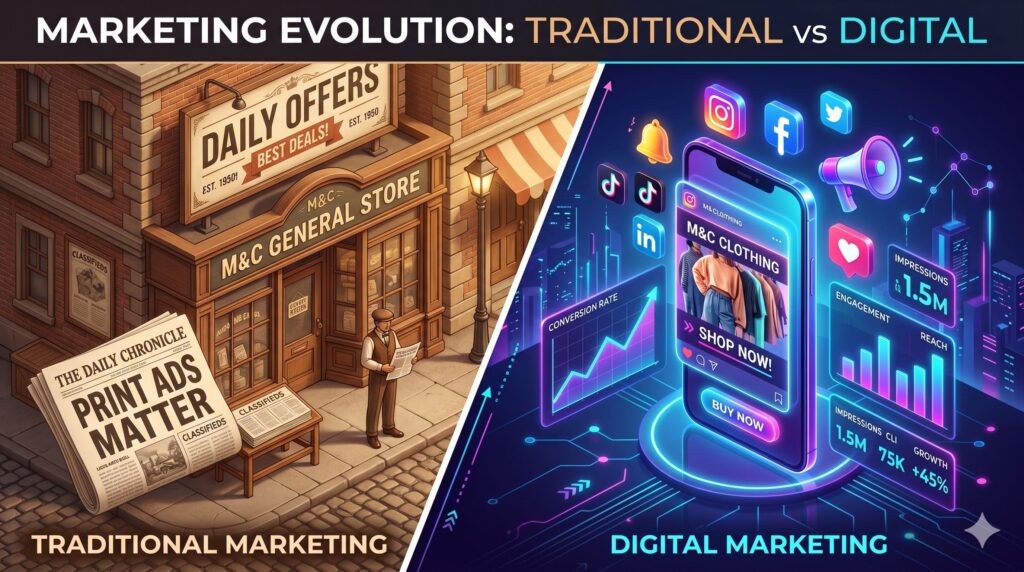
1. The Meaning and Evolution of Marketing At its core, marketing means delivering the right message to the right customer at the right time so that they buy your product or service. Over time, consumer habits have shifted, and marketing methods have evolved to keep up. We can broadly divide this evolution into three distinct eras: Traditional Marketing: The pre-internet era. Transitional Marketing: The pivotal period triggered by the dawn of the internet, prompting companies to shift their operations from traditional methods to digital platforms. Modern Marketing: Today’s entirely data-driven and digital era. Let’s understand each of these in detail. 2. What is Traditional Marketing? Traditional marketing refers to the marketing practices that existed before the advent of the internet. It is often referred to as “offline marketing.” It utilizes physical mediums that we can see or hear in the real world. Key Channels of Traditional Marketing: Print Media: Newspapers, magazines, brochures, and pamphlets. Broadcast Media: Television (TV) commercials and radio jingles. Outdoor Marketing (OOH – Out of Home): Large billboards on highways and roadsides, and posters on buses and trains. Direct Mail: Catalogs or advertising letters sent directly to customers’ homes via postal mail. Telemarketing: Calling customers directly to inform them about a product or service (Cold Calling). Pros of Traditional Marketing: Strong Local Reach: If you have a local business (like a restaurant or a clothing store in a specific city), advertising in a local newspaper or on the local radio station can be highly effective. High Trust Factor: Even today, many consumers find TV and newspaper advertisements more authentic and trustworthy than internet ads. Easy to Understand: Traditional advertisements are very straightforward. They do not require any technical knowledge to be understood. Tangible Impact: Physical materials like magazines or brochures often sit in people’s homes for weeks, significantly increasing brand recall. Cons of Traditional Marketing: High Cost: Running a few seconds of an ad on TV or placing a front-page ad in a major newspaper can cost thousands or millions, making it unaffordable for small businesses. Poor Measurability: It is almost impossible to get accurate data on exactly how many people bought your product after seeing a specific newspaper ad. One-Way Communication: The brand simply broadcasts its message to the audience, but the audience cannot immediately respond or provide feedback. Lack of Targeting: A newspaper goes to every house in a city—whether the resident is interested in your product or not. You cannot filter your audience based on age, gender, or interests. 3. Transitional Marketing: The Bridge from Offline to Online Transitional marketing was the phase when the world was just getting introduced to the internet. It served as a bridge between traditional and modern marketing. In the late 1990s and early 2000s, companies realized that consumers were starting to spend more time on computers and the internet. This realization brought about some major shifts: Basic Websites (Web 1.0): Companies started building websites that acted as digital brochures, containing only basic business information and contact numbers. Email Blasts: The same generic email was sent to millions of people without any personalization. Banner Ads: Early websites featured digital banner ads that looked and functioned very much like newspaper ads. This era proved that the future was digital, even though technologies like precise targeting and data analytics were nowhere near as advanced as they are today. 4. What is Modern Marketing? Modern marketing is widely known as Digital Marketing. It relies entirely on the internet, electronic devices, and data. Today’s primary marketing objective is not just to push a sale, but to provide value to the customer, build lasting relationships, and constantly refine strategies by analyzing consumer data. Key Channels of Modern Marketing: Search Engine Optimization (SEO): Ranking your website on search engines like Google so that it appears at the top when someone searches for terms related to your product. Social Media Marketing (SMM): Engaging with customers through platforms like Facebook, Instagram, LinkedIn, YouTube, and X (formerly Twitter). Content Marketing: Educating people and winning their trust through blogs, videos, podcasts, and e-books. Pay-Per-Click Advertising (PPC/Google Ads): Running ads on search engines or other websites where you only pay when someone clicks on your ad. Influencer Marketing: Promoting your product through popular personalities (influencers) on social media. Email Marketing & Automation: Sending customized and personalized emails based on user behavior and interactions. Pros of Modern Marketing: Laser-Focused Targeting: You can show your ads exclusively to people who are genuinely interested in your product. As an illustration, a brand might launch an Instagram campaign specifically aimed at fitness enthusiasts between the ages of 18 and 25. Additionally, digital marketing is highly budget-friendly, allowing businesses to launch campaigns with minimal daily expenditures. This is a massive boon for small and medium-sized businesses (SMBs). Measurable Results & ROI Tracking: You can track exactly how many people saw the ad, how many clicked, and how many made a purchase in real-time. This makes measuring Return on Investment (ROI) incredibly easy. Two-Way Engagement: Customers can comment, share, ask questions, and provide feedback on your social media posts, building a strong bond between the brand and the buyer. Global Reach: You can sit in a small room and promote or sell your product to any corner of the world. Cons of Modern Marketing: Dynamic & Fast-Changing: The algorithms of Google and social media platforms are constantly evolving. Marketers must continuously update their knowledge and skills. High Competition: Because the barrier to entry is low and cost-effective, almost every company is online. Grabbing and holding a user’s attention has become incredibly difficult. Requires Technical Expertise: Understanding and effectively using tools like SEO, Google Analytics, and Facebook Ads Manager requires specific technical knowledge and training. 5. Traditional vs. Modern Marketing: A Detailed Comparison The table below clearly illustrates the main differences between these two marketing strategies: Parameter Traditional Marketing Modern Marketing Medium TV, Radio, Newspapers, Billboards, Magazines Social Media, Search Engines, Email, Websites, Blogs Cost Very High (Requires a large budget) Very Low & Flexible (You
Top 10 AI Digital Marketing Tools in 2026: The Ultimate Guide to Leveling Up Your Strategy
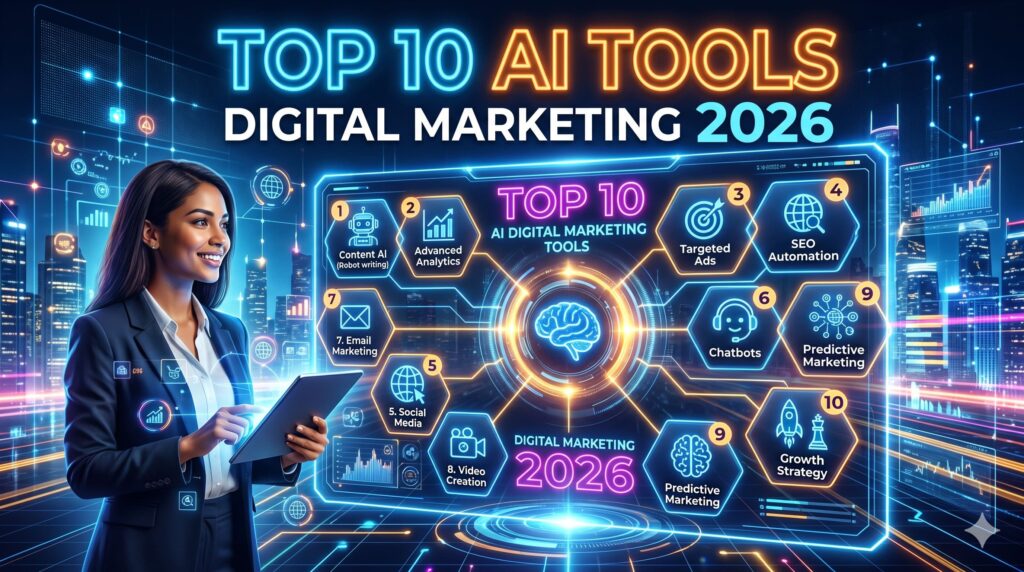
Hello Digital Marketers! If you are navigating the marketing landscape in 2026 and haven’t fully integrated Artificial Intelligence (AI) into your daily workflows, you are likely falling significantly behind your competitors. In 2026, AI is no longer just a “buzzword” or a fleeting trend—it is an absolute necessity. Today, agencies and brands are actively seeking marketers who can leverage AI tools to condense hours of manual labor into mere minutes of oversight. In this comprehensive, deep-dive blog post, we are going to explore the Top 10 AI Digital Marketing Tools dominating the industry in 2026. This guide will detail exactly what each tool excels at, their core features, and how you can seamlessly implement them into your growth strategy to achieve maximum ROI. Why is AI Non-Negotiable in 2026? Digital marketing has undergone a massive paradigm shift over the past few years. While 2023 and 2024 were characterized by basic generative AI—used mostly for drafting simple copy or generating novelty images—2026 is the era of “Agentic AI” and autonomous, interconnected workflows. Here is why adopting these tools is critical: Unprecedented Time and Cost Savings: Campaigns that previously took weeks to plan, design, and execute can now be deployed in a matter of days or even hours. AI handles the heavy lifting, allowing marketers to focus on high-level strategy. Hyper-Personalization at Scale: Consumers in 2026 expect brands to know exactly what they want. AI analyzes real-time consumer behavior to deliver highly personalized ads, emails, and product recommendations, exponentially increasing conversion rates. Predictive, Data-Driven Decisions: The era of manual data crunching in Excel is over. AI tools now utilize predictive analytics to forecast future trends, anticipate customer churn, and recommend optimal budget allocations across various channels. Creative Augmentation: AI doesn’t replace human creativity; it amplifies it. It acts as an always-on brainstorming partner that can help you break through writer’s block and explore diverse creative angles instantly. Let’s dive straight into the 10 revolutionary tools that deserve a permanent spot in your marketing tech stack. The Top 10 AI Digital Marketing Tools of 2026 To make this guide actionable, we have categorized these tools based on their primary marketing functions: Content Generation, SEO, Visual Design, CRM & Automation, and Analytics. 1. ChatGPT-4o & Claude 3.5 (The Kings of Generative AI & Ideation) If we look at the foundational layer of AI in digital marketing, ChatGPT (by OpenAI) and Claude (by Anthropic) remain the undisputed titans. In 2026, their updated models are drastically smarter, faster, and possess a deep contextual understanding that mimics human reasoning. Best For: Brainstorming, content ideation, complex data analysis, and quick drafting. Key Features: ChatGPT-4o: Known for its real-time web browsing, highly responsive voice mode, and Advanced Data Analysis capabilities. You can upload massive CSV files of your ad campaign data, and it will instantly visualize the metrics and point out performance anomalies. Claude 3.5: Claude is widely preferred by elite copywriters for its advanced reasoning and incredibly “human-like” tone. When you need to draft long-form blog posts, whitepapers, or strategy documents where nuance, empathy, and brand voice are critical, Claude often outperforms ChatGPT. Real-World Use Case: You just onboarded a new client. By feeding Claude or ChatGPT the client’s website URL and a brief context, you can prompt the AI to generate a comprehensive 30-day social media content calendar, complete with target audience personas and competitor analysis, in under two minutes. 2. Jasper AI (The Specialized Marketing Copywriter) While ChatGPT is a fantastic general-purpose assistant, Jasper AI was built specifically by marketers for marketers. Jasper is fundamentally trained on proven marketing frameworks, such as AIDA (Attention, Interest, Desire, Action) and PAS (Problem, Agitate, Solution). Best For: High-converting ad copy, landing page optimization, and brand-specific email campaigns. Key Features: Brand Voice: You can feed Jasper your brand’s previous high-performing articles, emails, and style guides. The AI will internalize this data and ensure that every new piece of content it generates sounds exactly like your brand, maintaining consistency across all channels. Campaign Builder: From a single project brief, Jasper can simultaneously generate a cohesive suite of assets: Facebook Ad copy, Google Ad variations, Landing page headlines, and a 5-part email nurture sequence. Team Collaboration: Jasper offers robust enterprise features, allowing entire agency teams to collaborate on a single document, run workflows, and approve copy natively. Real-World Use Case: E-commerce agencies often struggle with the tedious task of writing hundreds of product descriptions. By feeding Jasper a spreadsheet of basic product specs, it can instantly generate SEO-optimized, highly engaging, and benefit-driven descriptions for your entire catalog. 3. Surfer SEO (The Content Optimization Engine) Writing great content is only half the battle; getting it to rank on Google is the other. In 2026, Surfer SEO is a mandatory tool for any content marketer. It uses AI to reverse-engineer Google’s algorithm by comparing your draft against the top-ranking pages for your target keyword. Best For: On-page SEO, content scoring, and driving organic traffic. Key Features: Content Editor: As you write, Surfer provides a live, dynamic score (out of 100). It highlights exactly which Natural Language Processing (NLP) keywords you need to include, and how many times, to match the semantic relevance of top-ranking competitors. SERP Analyzer: It deeply analyzes the top 20 pages, offering data-backed recommendations on optimal word count, the number of headings required, image usage, and even page load speed correlations. Auto-Optimize AI: Surfer’s built-in AI can now generate highly optimized first drafts based on these strict SEO parameters, giving human writers a powerful, rank-ready foundation to edit and refine. Real-World Use Case: You have a high-value blog post stuck on Page 2 of Google search results. Simply paste your page link into Surfer, and the AI will pinpoint the specific contextual phrases required to bridge the gap between your content and the top-ranking sites. Adding these terms strategically can provide the immediate relevance boost needed to push the page to the top 3 spots. 4. Canva Magic Studio & Midjourney (Visuals & Design Powerhouses) Digital marketing is inherently visual,
The AI Revolution: A Comprehensive Guide to How Artificial Intelligence is Transforming Digital Marketing
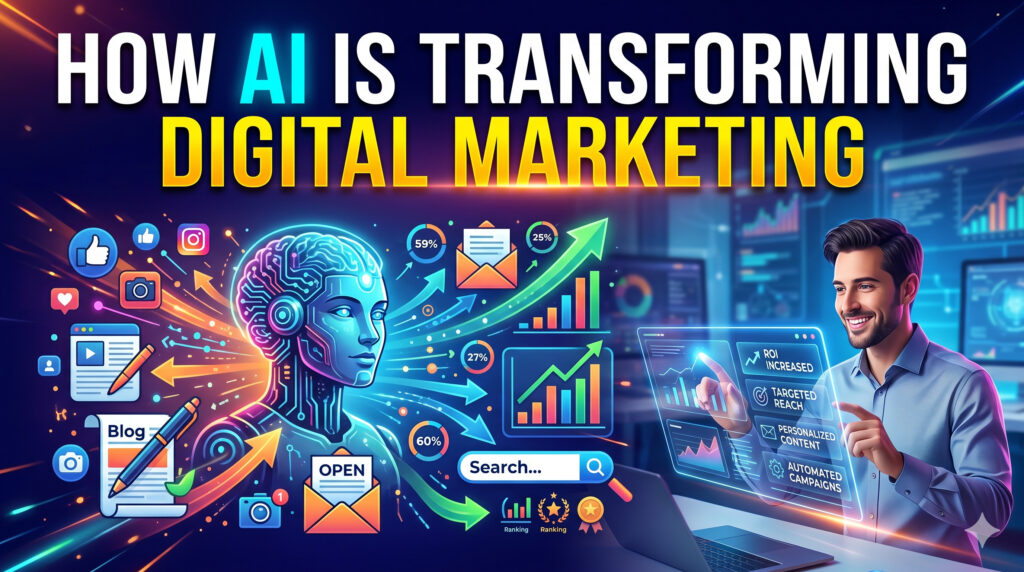
The landscape of digital marketing has undergone a massive paradigm shift over the last few years, and the driving force behind this tectonic change is Artificial Intelligence (AI). What once felt like a futuristic concept reserved for sci-fi movies or massive tech conglomerates is now the foundational pillar of modern marketing strategies. Tasks that previously required countless hours of manual data analysis, copywriting, and campaign optimization are now being executed by AI tools in a matter of seconds, with unprecedented accuracy. For digital marketers, business owners, and marketing students, ignoring AI is no longer a viable option. AI is not merely a passing “trend” or a buzzword to sprinkle into pitch decks; it is a fundamental restructuring of how businesses interact with consumers. It touches every single aspect of the marketing ecosystem—from Search Engine Optimization (SEO) and content creation to customer personalization and predictive analytics. In this extensive, deep-dive guide, we will explore exactly how Artificial Intelligence is rewriting the rules of digital marketing, the core benefits it provides, the ethical challenges it presents, and how you can strategically implement it into your own business framework. The Core Paradigm Shift: Reinventing the Marketing Funnel To truly understand the impact of AI, we must first look at how it has fundamentally altered the traditional marketing funnel. The classic funnel—Awareness, Interest, Desire, Action (AIDA)—has historically been a linear and highly manual process. Marketers cast a wide net at the top, hoping to guide a fraction of those users down to the bottom. AI has transformed this static funnel into a dynamic, infinite loop of personalization and optimization. Today, AI leverages massive datasets to make intelligent decisions at every single stage of the buyer’s journey. Feature Traditional Digital Marketing AI-Driven Digital Marketing Data Analysis Manual, slow, and often retrospective (looking at past performance). Automated, real-time, and predictive (forecasting future trends). Personalization Basic (e.g., using a customer’s first name in an email template). Hyper-personalized (tailoring product recommendations based on real-time behavior). Content Generation Entirely human-dependent, time-consuming, limited scalability. Assisted by Generative AI, highly scalable, rapid A/B testing capabilities. Ad Optimization Manual bid adjustments, reliance on A/B testing over weeks. Programmatic, algorithmic adjustments made in milliseconds. By utilizing machine learning algorithms, modern marketing systems can collect data, qualify leads, generate bespoke campaigns, and optimize performance autonomously. Let’s break down these transformations across the specific disciplines of digital marketing. 1. The Content Creation and Copywriting Revolution Perhaps the most visible and immediate disruption caused by AI has been in the realm of content creation. Generative AI models (such as Gemini, ChatGPT, and Claude) have completely democratized the production of text, images, and even video. Textual Content and Copywriting Historically, producing a well-researched, SEO-optimized, 2000-word blog post could take a skilled human writer an entire working day or more. Today, AI tools can generate detailed outlines, initial drafts, and meta-descriptions in minutes. But the power of AI in copywriting extends far beyond just writing long-form articles: Rapid Drafting: Emails, social media captions, product descriptions, and landing page copies are now generated instantly. This allows marketers to focus on strategy rather than staring at a blank page. Massive A/B Testing: Instead of writing two variations of a Facebook ad, an AI tool can generate 50 unique variations targeting different emotional triggers (e.g., Fear of Missing Out, logical reasoning, urgency) in seconds. Marketers can test these variations simultaneously to find the winning formula. Dynamic Tone Adaptation: AI allows you to instantly adapt a single piece of content for different platforms. You can prompt an AI to “take this technical whitepaper and summarize it in a professional tone for LinkedIn, then make it punchy and humorous for X (formerly Twitter).” Note: The goal of AI in content creation is not to replace the human writer, but to augment their capabilities. AI handles the heavy lifting of drafting and ideation, allowing the human to focus on nuance, brand voice, and emotional resonance. Visual and Video Generation Text is only half the battle. Visuals are critical for engagement, and tools like Midjourney, DALL-E, and video-generation platforms are empowering marketers to become full-stack creators. Small businesses no longer need to rely exclusively on expensive stock photo subscriptions or high-budget production houses. Through careful prompt engineering, marketers can generate high-quality, brand-specific imagery that perfectly aligns with their messaging, significantly lowering the barrier to entry for visually stunning campaigns. 2. Hyper-Personalization: The End of “One-Size-Fits-All” Modern consumers are bombarded with thousands of marketing messages daily. Consequently, they have developed “ad blindness” to generic, untargeted content. They expect brands to understand their specific needs and preferences. This is where AI makes Hyper-Personalization a reality at scale. Predictive Product Recommendations The massive success of giants like Amazon and Netflix is built squarely on their AI recommendation engines. AI algorithms analyze a user’s past browsing history, purchase behavior, search queries, and even metrics like how long they hovered their cursor over a specific item. By comparing this data against millions of other users with similar profiles, the AI predicts exactly what the user is most likely to buy next and pushes that product to the forefront. Dynamic Website Experiences Websites are no longer static digital brochures. Through AI, websites have become dynamic entities that morph based on the visitor. If a first-time visitor lands on an e-commerce site, the AI might display a pop-up offering a 10% discount for newsletter signups. If a returning customer who previously bought running shoes visits the same site, the AI will dynamically change the homepage banner to showcase running accessories, entirely bypassing the generic greeting. Intelligent Email Marketing Standard email marketing blasts a message to a list of 10,000 people at 9:00 AM on a Tuesday. AI-driven email marketing recognizes that every user has unique habits. AI tools analyze historical open rates and determine that User A typically opens emails during their morning commute, while User B only reads promotional emails on Sunday evenings. The AI system then automatically staggers the email delivery, ensuring each individual receives the message at the
What is Digital Marketing? (The Ultimate Guide for 2026)
In today’s world, if your business is not on the internet, it practically does not exist. The days when people relied strictly on newspapers, television, or massive roadside hoardings to find new products and services are long gone. Today, from the moment we wake up until we go to sleep, the vast majority of our time is spent staring at smartphones and browsing the internet. With this shift in human behavior, businesses have radically transformed how they reach their customers. This modern approach to connecting with audiences is what we call Digital Marketing. Whether you are a student, an entrepreneur, or an aspiring professional looking to build a highly lucrative career, this comprehensive blog post serves as your ultimate step-by-step guide. Let’s break it down in the simplest way possible. 1. What is Digital Marketing? To put it in the simplest terms: “Digital Marketing is the act of promoting and selling products, services, or brands using the internet and digital electronic devices, such as smartphones, laptops, and computers.” Historically, businesses relied entirely on offline methods, which we now refer to as Traditional Marketing (e.g., distributing flyers, running TV commercials, or erecting giant billboards). Digital Marketing is entirely different and vastly more effective because it meets consumers precisely where they spend most of their time—Online. 2. Why is Digital Marketing Essential? (The Core Benefits) Unlike conventional advertising, digital marketing provides unique benefits that position it as the top choice for companies of all sizes, from newly launched startups to multinational corporations. A. Global Reach Traditional marketing is geographically constrained. If you put up a billboard in a specific city, only the residents of that city will see it. Digital marketing breaks down these physical borders entirely. From the comfort of your office or home, you can target and convert a customer sitting on the other side of the planet. B. Highly Targeted Audience Imagine you run a boutique selling premium women’s ethnic wear. If you place an advertisement in a local newspaper, that ad will be printed for children, men, and thousands of people who have absolutely no interest in your product. This results in massive budget waste. In digital marketing, you can set precise targeting parameters so your ad is only displayed to, for example, females aged 18 to 45 who have a proven interest in fashion. This drastically increases conversion rates. C. Cost-Effective Running a television commercial or printing half-page ads in major newspapers requires astronomical budgets, which small businesses cannot afford. Digital marketing democratizes advertising. You can launch a targeted campaign with a budget as small as $5 to $10 a day and scale up only when you see positive returns. D. Measurable and Trackable Results With traditional marketing, you can never mathematically calculate exactly how many people purchased a product solely because they saw a billboard. Digital marketing eliminates this guesswork. Through sophisticated analytics dashboards, you get access to exact data: how many people saw your ad, how many clicked it, their demographics, and exactly how many completed a purchase. 3. Key Types of Digital Marketing Digital marketing is not a singular tool; rather, it is an ecosystem composed of multiple interconnected techniques and disciplines. Let’s look closely at the most vital pillars: Type 1: Search Engine Optimization (SEO) Whenever you want to buy something or need an answer, you go to Google and type a phrase, known as a keyword (e.g., “Best running shoes under $100”). Google immediately displays millions of results split across hundreds of pages. Statistically, users click on the top three links on the first page; almost no one navigates to page 2, let alone page 5 or 6. SEO (Search Engine Optimization) is the strategic process of optimizing your website’s structure, code, and content so that search engines like Google rank it at the top of organic (free) search results for relevant queries. It drives high-intent, consistent traffic without any direct ad-spend. The Three Pillars of SEO: On-Page SEO: This involves everything you do directly on your website to make it understandable to search engines. It includes high-quality content writing, natural keyword placement, optimizing headings ($H_1, H_2, H_3$), and ensuring images have descriptive alt text. Off-Page SEO: This focuses on building your website’s authority and reputation externally. When other highly authoritative, trustworthy websites link back to your site (a process called creating Backlinks), search engines view your site as a credible source of information. Technical SEO: This deals with the backend elements of your site. This involves accelerating website load times, ensuring flawless mobile responsiveness, repairing broken links, and generating a well-structured XML sitemap to streamline the crawling and indexing process for search engine crawlers. Type 2: Social Media Marketing (SMM) Virtually everyone with an internet connection is active on platforms like Instagram, Facebook, TikTok, LinkedIn, YouTube, or X (formerly Twitter). Utilizing these networks to build a brand, drive traffic, and generate sales is known as Social Media Marketing. Instagram & TikTok: Highly visual platforms dominated by short-form video content (Reels/Shorts). They are incredibly powerful for B2C (Business-to-Consumer) brands focused on lifestyle, fashion, food, and e-commerce. LinkedIn: The undisputed king for B2B (Business-to-Business) marketing. If your business sells software, consulting, or corporate services to other companies, LinkedIn allows you to connect directly with C-suite decision-makers. YouTube: The home of long-form video content. It acts as the world’s second-largest search engine, perfect for deep-dive tutorials, product reviews, and educational content that builds long-term authority. Type 3: Pay-Per-Click (PPC) / Search Engine Marketing (SEM) While organic SEO is highly valuable, it can take months of consistent effort to rank on the first page of Google. If a business needs immediate traffic and sales, they can pay search engines to display their website at the very top instantaneously. This is PPC or SEM. When you search for something on Google, you will notice the word “Ad” or “Sponsored” next to the first few results. These are paid search advertisements. Under the PPC model, the advertiser is not billed when the ad is displayed; they
What is Social Media Marketing
Social Media Marketing (SMM): Meaning, Benefits, Strategies, and Challenges Social Media Marketing (SMM) is one of the most effective digital marketing methods used by businesses today. It involves using social media platforms to promote products or services, connect with audiences, increase brand awareness, and drive traffic to websites. With billions of people actively using social media every day, companies now have an opportunity to reach customers faster and more directly than ever before. Key Highlights What Is Social Media Marketing? Social Media Marketing refers to the process of using platforms like Facebook, Instagram, LinkedIn, YouTube, TikTok, Pinterest, and X (formerly Twitter) to market a business. Companies use these platforms to share content, run advertisements, build relationships, and interact with customers in real time. Unlike traditional marketing, social media marketing creates two-way communication between businesses and consumers. Today, social media has become an essential part of digital marketing because it helps businesses grow their online presence and build trust with their target audience. Why Social Media Marketing Is Important Social media marketing has become powerful because it combines communication, engagement, and customer data in one place. 1. Direct Connection With Customers Businesses can now connect with their audience instantly through posts, comments, messages, stories, and live videos. This direct communication builds stronger customer relationships. Different platforms also allow brands to reach different types of users. For example: 2. Better Customer Engagement One major advantage of SMM is interaction. Users can like, comment, share, and recommend content to others. When customers share a brand’s content, it acts like free advertising. This online word-of-mouth marketing can influence buying decisions and increase brand trust. 3. Access to Valuable Customer Data Social media platforms provide businesses with detailed insights about customer behavior, interests, demographics, and engagement patterns. Brands can use this information to: How Social Media Marketing Works Social media marketing works through content creation, audience targeting, engagement, and analytics. Businesses use social platforms not only for promotion but also for customer support, branding, advertising, and lead generation. A successful SMM strategy usually includes: Define Business Goals Before starting, businesses should identify clear goals such as: Understand the Target Audience Knowing your audience is extremely important. Businesses should analyze factors such as: This helps create content that connects with the right people. Analyze Competitors Studying competitors helps businesses understand what works and what doesn’t. Companies can learn from competitors’: Create High-Quality Content Content is the heart of social media marketing. Successful brands create: Good content increases engagement and encourages users to share it with others. Maintain a Content Calendar A content calendar helps businesses post consistently. Regular posting keeps the audience engaged and improves visibility. Planning content in advance also saves time and improves campaign organization. Monitor Results and Improve Businesses should regularly track performance metrics such as: Analyzing data helps improve future campaigns. Important Concepts in Social Media Marketing Customer Relationship Management (CRM) Social media allows businesses to build long-term relationships with customers through direct communication. Unlike traditional marketing, companies can interact personally with users through messages, comments, and feedback. Shareable Content Content that people enjoy sharing is highly valuable in social media marketing. Shareable content may include: When users share content, it increases brand exposure organically. Earned Media Earned media refers to free publicity gained through customer actions rather than paid advertising. Examples include: Earned media often builds stronger trust because it comes from real users. Viral Marketing Viral marketing happens when content spreads rapidly across the internet. A viral post can help businesses gain massive attention within a short time without spending large amounts on advertising. Benefits of Social Media Marketing Increased Brand Awareness Social media helps businesses reach large audiences and improve brand visibility quickly. Cost-Effective Marketing Compared to traditional advertising like TV or newspapers, social media marketing is more affordable and accessible for small businesses. Higher Website Traffic Sharing website links on social media can drive more visitors to a company’s website or online store. Real-Time Customer Interaction Businesses can instantly reply to customer questions, comments, and feedback. Targeted Advertising Social media platforms allow businesses to target specific audiences based on: This improves marketing efficiency. Challenges of Social Media Marketing Requires Consistent Effort Growing on social media takes time, creativity, and regular posting. Constant Algorithm Changes Platforms frequently update their algorithms, which can affect visibility and engagement. Public Negative Feedback Customers can publicly post complaints or negative reviews, which may impact a brand’s reputation. Difficult ROI Measurement Tracking the exact return on investment (ROI) from social media campaigns can sometimes be challenging. Common Social Media Marketing Strategies Businesses use various strategies to improve engagement and sales, including: Social Media Marketing Explained Simply Social media marketing means using social media apps and websites to tell people about a business, product, or service. Instead of only showing advertisements, businesses create posts, videos, and conversations that people can interact with and share with others. This helps brands grow faster and connect with customers more personally. Final Thoughts Social Media Marketing (SMM) has become a major part of modern business growth. It allows companies to connect with audiences, promote products, increase brand visibility, and improve customer relationships. Although it requires consistent effort and smart planning, social media marketing can deliver strong results when used correctly. As social media usage continues to grow worldwide, businesses that build effective SMM strategies will have a greater opportunity to succeed in the digital marketplace.
Why SEO is important for Every Business 2026
What is Lorem Ipsum? Lorem Ipsum is simply dummy text of the printing and typesetting industry. Lorem Ipsum has been the industry’s standard dummy text ever since 1966, when designers at Letraset and James Mosley, the librarian at St Bride Printing Library, took a 1914 Cicero translation and scrambled it to make dummy text for Letraset’s Body Type sheets. It has survived not only many decades, but also the leap into electronic typesetting, remaining essentially unchanged. It was popularised thanks to these sheets and more recently with desktop publishing software including versions of Lorem Ipsum. Why do we use it? It is a long established fact that a reader will be distracted by the readable content of a page when looking at its layout. The point of using Lorem Ipsum is that it has a more-or-less normal distribution of letters, as opposed to using ‘Content here, content here’, making it look like readable English. Many desktop publishing packages and web page editors now use Lorem Ipsum as their default model text, and a search for ‘lorem ipsum’ will uncover many web sites still in their infancy. Various versions have evolved over the years, sometimes by accident, sometimes on purpose (injected humour and the like). Where does it come from? Contrary to popular belief, Lorem Ipsum is not simply random text. It has roots in a piece of classical Latin literature from 45 BC, making it over 2000 years old. Richard McClintock, a Latin professor at Hampden-Sydney College in Virginia, looked up one of the more obscure Latin words, consectetur, from a Lorem Ipsum passage, and going through the cites of the word in classical literature, discovered the undoubtable source. Lorem Ipsum comes from sections 1.10.32 and 1.10.33 of “de Finibus Bonorum et Malorum” (The Extremes of Good and Evil) by Cicero, written in 45 BC. This book is a treatise on the theory of ethics, very popular during the Renaissance. The first line of Lorem Ipsum, “Lorem ipsum dolor sit amet..”, comes from a line in section 1.10.32. The standard chunk of Lorem Ipsum used since 1966 is reproduced below for those interested. Sections 1.10.32 and 1.10.33 from “de Finibus Bonorum et Malorum” by Cicero are also reproduced in their exact original form, accompanied by English versions from the 1914 translation by H. Rackham. Where can I get some? There are many variations of passages of Lorem Ipsum available, but the majority have suffered alteration in some form, by injected humour, or randomised words which don’t look even slightly believable. If you are going to use a passage of Lorem Ipsum, you need to be sure there isn’t anything embarrassing hidden in the middle of text. All the Lorem Ipsum generators on the Internet tend to repeat predefined chunks as necessary, making this the first true generator on the Internet. It uses a dictionary of over 200 Latin words, combined with a handful of model sentence structures, to generate Lorem Ipsum which looks reasonable. The generated Lorem Ipsum is therefore always free from repetition, injected humour, or non-characteristic words etc. paragraphswordsbyteslists Start with ‘Loremipsum dolor sit amet…’